Maritime Telemetry: How Telik Geter Optimized Vessel Monitoring
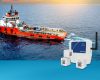
In maritime operations, especially in offshore support vessels (ships that support the offshore oil and gas industry by transporting equipment, performing maneuvers, and ensuring the continuity of activities on offshore platforms), the reliability of propulsion and steering systems is essential to guarantee crew safety, operational continuity, and asset availability.
It was precisely this challenge that led a NOVUS system integrator to seek a solution capable of continuously monitoring the condition of its vessels’ most critical equipment.
The need arose after problems occurred in an azimuth thruster system—equipment responsible for vessel steering and propulsion. The failure required a high-cost intervention and highlighted the importance of increasing visibility into the health of onboard assets.
Beyond financial impacts, a failure in propulsion systems can seriously compromise operations, resulting in vessels losing maneuverability or even drifting at sea.
The Scenario Before Continuous Monitoring
Although vessels have maintenance teams monitoring operations full-time, problem identification relied mainly on visual inspections, perception of abnormal noises, or other already evident signs of degradation.
In practice, this meant many anomalies could only be detected when equipment was already nearing a critical failure condition.
In an operational environment where equipment operates under high loads and severe conditions, the lack of continuous information on vibration and temperature made it difficult to anticipate problems and make data-driven decisions.
The Solution: Condition Monitoring with Telik Geter
To increase visibility into the vessel’s critical assets, the integrator implemented a solution based on Telik Geter for continuous vibration and temperature monitoring.
The project was developed on an offshore support vessel operating in activities related to the oil and gas industry, using satellite internet communication available on the vessel.
Twenty Telik Geter units were installed at strategic points on the vessel, with an initial focus on propulsion and steering systems.
Among the monitored assets are the main engine bearings, considered critical components for operation. Each engine has four monitored bearings, totaling eight measurement points on the vessel’s two 1,500 hp engines, identified as MCP BB (port) and MCP EB (starboard).
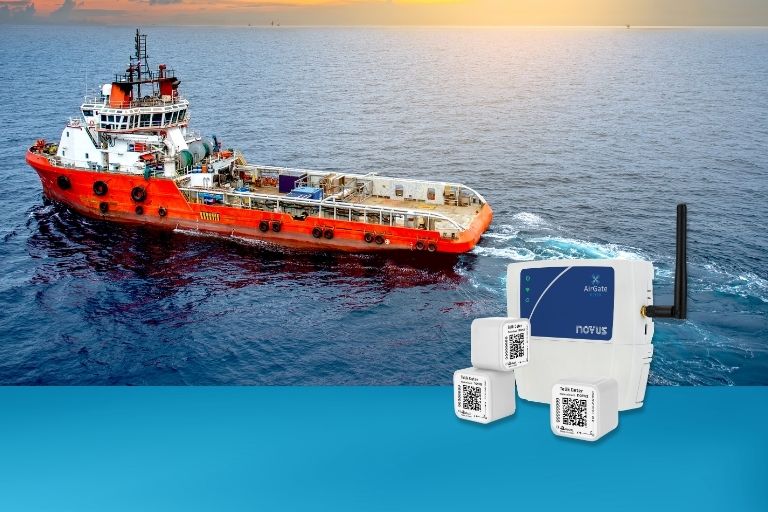
The solution combines Telik Geter sensors installed directly on the assets with the AirGate Geter gateway, responsible for securely concentrating and transmitting information. The Telik Geter sensors have an IP69K protection rating, one of the highest for industrial equipment, guaranteeing resistance to high-pressure water jets. This characteristic allows reliable operation in severe environments constantly exposed to water, such as port facilities, vessels, and offshore applications, where device robustness and durability are essential for monitoring continuity.
The data is integrated into the supervisory system developed by the integrator using the Elipse platform, allowing real-time monitoring through dedicated screens installed on the vessel. Telik Geter also has its own platform, where the customer can remotely access their operation, allowing full-time internet access.
The Differential: Monitoring What Could Not Previously Be Measured
One of the project’s main benefits was the possibility of continuously monitoring bearing temperature.
According to the team responsible for implementation, this was a parameter considered strategic by the customer, especially since similar problems had occurred on other vessels without adequate means for continuous tracking.
In addition to temperature, Telik Geter provides vibration information with high sampling frequency, allowing the identification of behavioral changes that might go unnoticed in conventional systems based on readings spaced minutes apart.
With measurements taken at intervals of up to one second, the solution expands anomaly detection capability, contributing to a maintenance approach based on the actual condition of the equipment.
Results: More Predictability and Reduced Operational Risks
Although the project’s financial indicators are still under evaluation, operational gains are already evident.
The main achievement was the implementation of a predictive maintenance strategy for the vessel’s critical assets, providing greater predictability regarding the behavior of propulsion and steering systems.
Among the observed benefits are:
- Continuous monitoring of critical asset condition;
- Real-time visibility of bearing temperature;
- Tracking of vibration and temperature trends;
- Early identification of possible anomalies;
- Reduction of the risk of unexpected failures at sea;
- Increased operational reliability of the vessel;
- Support for data-driven decision-making.
In maritime operations, preventing a single critical failure can represent significant savings in maintenance costs, mobilization, asset unavailability, and operational impacts.
Project Expansion
The success of the initial implementation paves the way for expanding monitoring to other vessel assets, including engines and additional equipment considered essential for operation.
The solution’s scalability is also an important differentiator. While this vessel received 20 sensors, a single vessel can use up to about 100 units to monitor all critical assets.
Furthermore, the customer operates approximately 150 vessels, creating opportunities to expand the condition monitoring strategy to an even larger fleet.
Count on NOVUS
By implementing Telik Geter in its propulsion and steering systems, the company took an important step toward a more predictable, safe, and data-driven operation.
With continuous vibration and temperature monitoring, robust connectivity even in maritime environments, and integration with supervisory systems, the solution enables maintenance teams to identify early signs of degradation before they evolve into high-impact failures.
The result is a more reliable operation, prepared to reduce risks, increase asset availability, and strengthen the predictive maintenance strategy on vessels performing critical activities in the offshore sector.
About Telik Geter
Telik Geter was developed for continuous vibration and temperature monitoring of critical assets, providing a more detailed view of equipment operating conditions. With a sampling rate of up to 1 second, the solution allows identification not only of failure indicators for predictive maintenance but also of process deviations and anomalies that could go unnoticed in systems that collect data at minute intervals.
The solution consists of the Telik Geter sensor, installed directly on the asset to perform measurements, and the Airgate Geter gateway, responsible for communication and secure transmission of information to the NOVUS Geter platform. The sensor operates completely wirelessly, simplifying installation and reducing infrastructure costs. Additionally, it features a long-lasting battery with a lifespan of up to 10 years, depending on the configured sampling rate.
Data communication can be performed with both the cloud platform and local systems. The solution uses the MQTT protocol for cloud integration and supports Modbus communication for connection with supervisory platforms and automation systems, such as Elipse. In the cloud, the NOVUS Geter platform offers complete asset management resources, including alarm configuration, creation of customized dashboards for real-time monitoring, and report generation for analysis and decision-making.