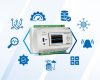
Modbus: why is the protocol still used after 40 years?
If you work in industrial automation, you’ve probably heard of (or use daily) the Modbus protocol.
Created in 1979, it was designed as a straightforward method to facilitate communication between controllers and other industrial devices. Since then, it has become one of the most widely used protocols in the automation world.
But with all the technological evolution over the last 40 years, one question arises: why is Modbus still so present in the industry, even with so many more modern technologies available?
What is Modbus?
Modbus is an industrial communication protocol based on a master-slave model (or client-server in Modbus TCP). It allows industrial devices (such as sensors, controllers, data loggers, and transmitters) to exchange information in a standardized, simple, and direct way.
There are two main versions:
Modbus RTU: runs over serial communication (RS-485/RS-232).
Modbus TCP: runs over Ethernet networks.
The protocol allows reading and writing data in device registers, making it easier to integrate with SCADA systems, PLCs, HMIs, and control systems.
Why is Modbus still widely used?
Even after four decades, some factors explain the incredible longevity of Modbus:
Simplicity
It is extremely easy to understand, implement, and troubleshoot. Its data structure is simple, based on well-defined registers.
Low cost
There are no licenses, royalties, or costs associated with its use. This makes it an economical choice, especially for cost-sensitive projects.
Device compatibility
Being open and widely adopted, Modbus allows communication between devices from different manufacturers, which is not always true with other protocols.
Large installed base
Millions of industrial devices use Modbus worldwide. This ensures huge compatibility with both new and legacy systems.
Stability and robustness
It is a mature protocol, tested and proven in critical applications, from simple processes to harsh industrial environments.
Communication flexibility
It works over both serial networks (Modbus RTU) and Ethernet (Modbus TCP), adapting to different operational scenarios.
Modbus vs Modern Protocols
When protocols like OPC UA, MQTT, Profinet, and EtherNet/IP emerged, many thought Modbus would become obsolete. In reality, that didn’t happen.
Yes, these protocols offer advantages such as built-in security, event-driven communication, and scalability for cloud and IIoT. However, Modbus remains unbeatable in applications where you need:
- Low cost,
- Easy implementation,
- Simplicity in data exchange on the shop floor.
What we see today is coexistence between technologies: Modbus continues to be used at the operational level (sensors, data loggers, controllers), while protocols like MQTT bridge the gap to the cloud and analytics systems.
NOVUS products that use Modbus
At NOVUS, we continue adopting Modbus as a communication standard for its reliability, compatibility, and efficiency. It is present in several products in our portfolio, such as:
N20K48 – Our modular process controller comes with native Bluetooth and uses Modbus RTU for integration with PLCs, HMIs, and SCADA systems. When equipped with the Wi-Fi module, it also offers Modbus TCP communication, expanding its connectivity possibilities.
DigiRail IoT – Smart transmitter for analog and digital signals, with Modbus TCP and RTU, ready for both local automation and IIoT integration;
FieldLogger – Industrial data logger that uses Modbus RTU and TCP to communicate with sensors, controllers, and SCADA systems. Now also features the MQTT protocol;
Climate Air+ – Temperature and humidity sensor with Modbus communication option, plus wireless connectivity via radio.
This compatibility allows our products to be easily integrated into new or existing systems, whether based on traditional technologies or modern Industry 4.0 and IIoT architectures.
The answer to the initial question is clear: Modbus is still alive because it works.
It is simple, reliable, inexpensive, robust, and universal. Instead of being replaced, it has evolved to coexist with new technologies, especially when combined with IoT solutions and cloud integration.
Now and in the future, Modbus will continue to be a key component in the industrial automation ecosystem.
Want to know more about how our products combine Modbus with IoT? Visit our website and talk to a specialist.