Checklist: how to evaluate the best data acquisition system for your industry
Choosing a data acquisition system goes far beyond simply recording values. In industrial applications, what’s at stake is the ability to measure accurately, record with traceability, integrate with other systems, and act quickly when something deviates from expectations.
Whether for cold chains, laboratories, HVAC, manufacturing, or renewable energy, it’s worth following a checklist before making a decision. Below are the key points to evaluate.
What to evaluate before choosing a data acquisition system
1) Variables and signal types
First, map which variables need to be monitored (e.g., temperature, humidity, pressure, voltage/current signals, digital states) and which sensors will be used. A good system must be compatible with your process sensors and signals to avoid adaptations, conversions, and future limitations.
2) Number of points and scalability
A data acquisition system must meet today’s needs and, most importantly, keep up with project growth. That’s why it’s important to estimate how many points will be monitored now and the expected expansion over the next few months (new areas, more equipment, additional traceability, or audit requirements).
It’s also worth considering whether the solution enables simple, standardized expansion without major architecture changes. In industrial projects, this predictability reduces rework and makes it easier to replicate the model across other lines or sites.
3) Reading rate and resolution
Another decisive point is understanding the level of detail you need to see in the process. In slower applications, sampling can be less frequent and still be sufficient for analysis. In processes with fast variations, critical events, or the need for more detailed diagnostics, the reading and logging rate must be higher to capture the variable’s real behavior.
In addition, resolution and accuracy directly affect data reliability: when the goal is to compare performance, validate corrective actions, or meet quality requirements, inconsistent measurements compromise decision-making.
4) Storage, history, and data integrity
The quality of the historical record is what turns data acquisition into evidence. More than “having a chart,” you must ensure the information will be recorded with integrity over time, with adequate storage capacity and practical ways to query and export data.
It’s also essential to assess how the system behaves in real field conditions, such as network instability or power outages. A well-specified project considers these scenarios from the start to avoid gaps in the history, often the most critical moments for analysis.
5) Connectivity and integration
In industrial environments, data must flow between the shop floor and supervision, analytics, and management systems. Therefore, evaluate whether the solution offers the interfaces and protocols best suited to your infrastructure, both for local integration and remote access.
The right choice simplifies implementation and scaling and enables broader use of data in SCADA systems, databases, reports, and, when applicable, cloud platforms. The better this step is solved, the lower the risk of the system becoming an “information island.”
6) Alarms and response to critical events
In many scenarios, recording data is only part of the goal: the system also needs to help you react when something deviates. Alarm features turn deviations into action, whether through notifications to the responsible team or local outputs for signaling or process protection.
It’s also important that these events are logged, creating traceability for investigation and continuous improvement. This is especially relevant when a deviation can cause direct losses—such as wasted inputs, rework, scrap, returns, or unplanned downtime.
7) Calculations and data processing
Instead of recording only “raw” signals, it may be useful to generate indicators and combinations (e.g., calculations, totals, logic). Systems with internal processing capabilities can reduce dependence on external layers and simplify applications.
8) Installation, power supply, and day-to-day operation
Beyond technical requirements, project feasibility depends on practical installation and operation. Evaluate available power options, the need for an auxiliary supply for transmitters, ease of mounting and maintenance, and, above all, how the system will be operated day to day.
When there is a local interface (such as a display/HMI), it can speed up diagnostics and field adjustments, reducing response time. In plants where different people interact with the equipment (operations, maintenance, quality), usability and standardization make a difference in keeping the system running consistently.
9) Compliance and traceability (when applicable)
For regulated sectors, verify data integrity and traceability requirements, such as standards and good practices. In some cases, meeting compliance requirements is decisive for enabling audits and validations.
How to turn data into decisions
A good data acquisition system combines signal compatibility, accuracy, reliable history, integration, alarms, and operational ease. Ultimately, these criteria directly impact response time to deviations, quality, losses, rework, and operating costs.
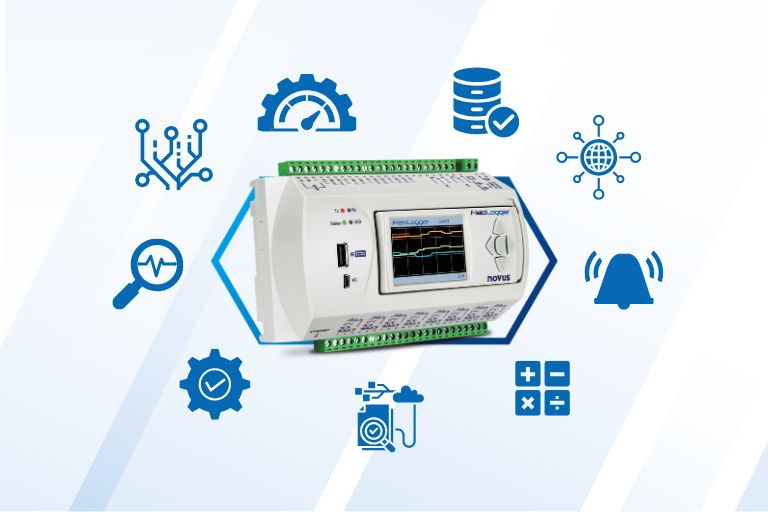
If you’re looking for a multi-channel industrial data logger that brings these criteria together in a single platform, NOVUS’ FieldLogger was designed for continuous monitoring of variables such as temperature, humidity, and analog and digital signals, with high connectivity and advanced features for logging, alarms, and integration.
Highlights include 8 universal analog inputs, configurable digital I/Os, memory expandable via SD card, Ethernet/USB/RS485 connectivity, Modbus support, features such as a web server, FTP, SNMP, and email notifications, plus MQTT communication for integration and data delivery to systems and cloud platforms, 32 configurable alarms, and virtual channels for calculations. It also meets compliance requirements such as FDA 21 CFR Part 11 when applicable in regulated environments.
Want to learn more? Visit the FieldLogger page or talk to a NOVUS specialist to properly size the solution for your application.