Environmental Monitoring vs Measurement: What’s the Difference?
In many industrial operations, temperature or humidity checks are still performed through spot readings. An operator consults an instrument, records a value, and assumes the environment is under control. While this practice is common, it does not constitute an environmental monitoring system.
The difference between measuring and monitoring may seem small, but in critical environments, it is essential to ensure quality, traceability, and operational safety. Understanding this difference is crucial to avoiding invisible risks in the process.
Measurement vs Monitoring: A Practical Comparison
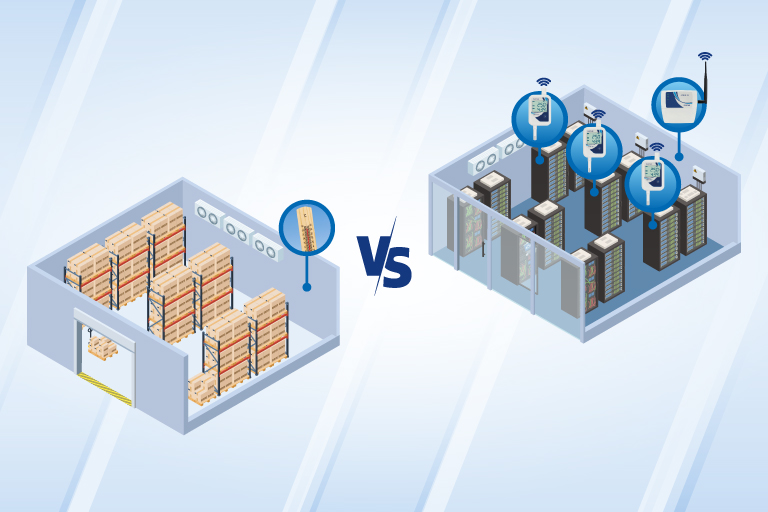
Measurement consists of capturing the value of a variable at a specific moment. A thermometer, sensor, or reading instrument indicates the temperature or humidity at that instant. This information only answers one question: what is the value right now?
This type of reading works like a snapshot of the process. It shows a momentary condition but does not reveal what happened before or what may happen afterward.
Environmental monitoring, on the other hand, tracks the behavior of variables over time. Sensors installed in the environment continuously collect data, allowing the recording of measurement history, identification of fluctuations, and detection of deviations.
While measurement shows only a single moment, monitoring reveals the full behavior of the environment.
This allows important operational questions to be answered:
- Did the environment remain within the acceptable range throughout the entire period?
- Were there fluctuations outside the limits during the day or night?
- How long was the process outside the ideal condition?
- When did a deviation occur, and what was its duration?
Without continuous tracking, this information simply does not exist.
The Risks of Relying Solely on Spot Measurements
In critical environments, relying only on isolated measurements can hide important problems.
Imagine a refrigerated chamber used to store medications or food. At the moment of manual verification, the temperature may be within the correct range. However, without continuous monitoring, it is impossible to know if a refrigeration failure or prolonged variation occurred during the night.
This lack of traceability can generate various operational issues, such as product quality loss, audit difficulties, and the inability to prove environmental conditions throughout the process.
For this reason, in many industrial and logistics applications, environmental control requires more than simple measurements. Continuous visibility of the environment must be ensured.
What Defines an Environmental Monitoring System
An environmental monitoring system combines sensors, data communication, and historical recording to continuously track variables such as temperature and humidity.
This type of solution allows automatic measurement collection, records variable behavior over time, and generates alerts if any deviation from defined conditions occurs.
Additionally, monitoring creates a reliable database that can be used for audits, performance analysis, and process improvement.
Thus, the operation no longer depends on spot checks and gains continuous and traceable environmental control.
How to Transform Measurements into Environmental Monitoring
The difference between measuring and monitoring goes beyond a technical issue: it defines the level of control an operation has over its own environmental conditions.
Spot measurements can indicate the momentary state of a variable, but only continuous monitoring allows understanding the real behavior of the environment, identifying deviations, and ensuring traceability of conditions over time.
In applications where stability, quality, and compliance are essential, transforming isolated measurements into a reliable monitoring system becomes critical.
The Climate Air+ solution by NOVUS was developed precisely for this scenario, allowing continuous monitoring of temperature and humidity in critical environments, recording measurement history, and responding quickly to any variation that could compromise the process.
The solution integrates the RHT Air+ and AirGate Air+ devices to enable continuous, precise, and scalable monitoring of temperature and humidity in critical environments such as pharmaceutical warehouses, data centers, and industrial areas.
Using LoRa technology for long-range communication and proprietary encryption for data protection, the system ensures data integrity, regulatory compliance, and greater operational reliability even in challenging conditions.
If your operation needs to go beyond spot measurements and ensure continuous, traceable, and reliable environmental monitoring, discover the Climate Air+ solution by NOVUS and learn how to turn environmental data into operational safety.
If you prefer, speak with a specialist.