How NOVUS ensured reliable environmental monitoring in a Data Center
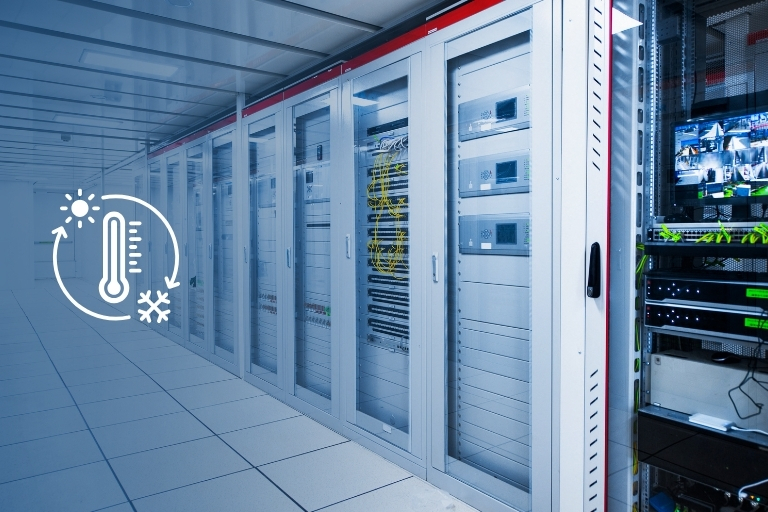
Temperature and humidity control are essential in various industrial sectors, including data centers, which are responsible for housing computing and networking equipment that can overheat or be damaged by high humidity.
The American Society of Heating, Refrigerating and Air-Conditioning Engineers (ASHRAE), in its Technical Committee 9.9, recommends that the air temperature at the inlet of IT equipment in data centers be maintained between 18 °C and 27 °C and the relative humidity between 40% and 60%. This range is considered ideal to ensure safe, efficient, and highly available operation.
The need: precise and real-time monitoring
One of the largest financial institutions in Brazil, with units in São Paulo and Paraná, faced difficulties in effectively monitoring temperature and humidity in its data centers. A NOVUS client, the company relied solely on manual measurements using thermo-hygrometers, requiring operators to access the “white floor” environment several times a day to record values. This process, in addition to being prone to human error and record inconsistency, also posed operational risks and health hazards for employees, especially due to the constant need to enter restricted areas.
One of the main problems with this manual method was the lack of immediate response to temperature or humidity excursions. Since detection depended on the next measurement, deviations were only noticed hours later—in some cases, up to four hours after the incident—preventing immediate alarm activation and putting the entire operation at risk.
The solution: RHT Air + AirGate Modbus + FieldLogger
NOVUS implemented the use of three products: RHT Air, AirGate Modbus, and FieldLogger. With RHT Air (Temperature and Humidity Transmitter) and AirGate Modbus (Wireless Modbus Gateway), it became possible to have reliable, real-time temperature and humidity monitoring. The FieldLogger served as a gateway, converting the AirGate protocol (Modbus RTU) to the Ethernet industrial network protocol (Modbus TCP) and providing data redundancy by recording to its memory. This enabled the integration of temperature and humidity readings into an EMS system.
The installation was simple, and within a few days, the company began receiving real-time data, improving its ability to respond to changes in environmental conditions.
Results: Agility and Operational Efficiency within 15 days, the client had already identified several benefits, such as:
- Reliable, real-time temperature and humidity data;
- Automatic alarm implementation to immediately detect excursions;
- We no longer need a human operator for measurements.
According to ASHRAE Technical Committee 9.9, maintaining temperature and humidity within recommended parameters also helps reduce energy consumption. In addition to the benefits above, the client achieved considerable energy savings by gaining insight into the thermal profile of its operation and using chilled air injection according to demand.
New Climate Air+ solution
In March 2025, we launched an update to the solution, now called Climate Air+, composed of the RHT Air+ and AirGate Air+. This version simplifies implementation by requiring less infrastructure. A single 8- 30V power point is sufficient for the AirGate Air+, and once the battery-powered RHT Air+ devices are paired, the system is ready to operate.
How it works in practice
The RHT Air+ is a temperature and humidity sensor that collects, records, and stores data in its internal memory. It sends this information directly to the AirGate Air+, which also records and reads the data and sends it online to a cloud or SCADA platform using Modbus TCP and MQTT protocols.
The devices communicate via radio, ensuring a stable connection even in environments with physical barriers, with a range of up to 3 km. This way, product movement does not affect data transmission.
With a storage capacity of up to 50 days with a 5-minute publishing interval, both devices ensure data safety even in extreme situations such as power outages.
The RHT Air+ operates with a non-rechargeable internal battery that can last up to two years, depending on the data publishing interval, or it can be powered via a USB-C port with a 5V DC source.
The AirGate Air+ is powered by an external 8 to 30V DC source. Each AirGate Air+ receives information from up to 32 RHT Air+ devices, forming islands of continuous, accurate, and secure monitoring.
Learn more about the solution on the product page of our website.