How to monitor temperature and humidity in pharma products
Medicines and vaccines only do their job when they reach their destination under the right conditions. That’s why controlling temperature and humidity throughout the entire journey—from warehouse to point of use—stops being a detail and becomes a foundation of quality.
When these variables fall outside the recommended range, product stability degrades, confidence drops, and the risk of disposal rises. Monitoring isn’t a luxury: it’s what ensures safety, compliance, and efficiency.
In this article, we explain why monitoring matters, what the standards require, what truly needs to be tracked, and how NOVUS products can support operations end to end.
Why monitor
Pharmaceutical products are sensitive. Repeated or prolonged fluctuations in temperature and humidity accelerate degradation and shorten shelf life, leading to compromised batches, rework, reverse logistics, tougher audits, and avoidable costs.
With continuous monitoring, failures are detected early, teams can act in real time, and decisions are backed by data.
What the standards require
Good Storage and Distribution Practices demand mapped, monitored, and documented environments.
For electronic records, references such as 21 CFR Part 11/Annex 11 require data integrity: knowing who did what, when, with an audit trail and role-based access. In practice: define ranges and alarms, calibrate sensors, standardize reports, and keep a complete, accessible history. This cuts debate during audits and makes the operation defensible.
What needs to be monitored
Start with critical points: cold rooms and refrigerators (2–8 °C), controlled areas (15–25 °C), cleanrooms, docks, receiving/dispatch areas, and transport—plus “worst case” points identified by thermal mapping (hot/cold spots, near doors and evaporators).
Measure temperature and, when relevant, relative humidity; track door openings and power outages.
Match sampling frequency to criticality: in cold chain, 1–5-minute intervals reveal short excursions that hourly checks won’t catch—or will catch too late.
To represent product behavior, use thermal masses or equivalent media when needed. This reduces false alarms and brings readings closer to real conditions.
How to build a simple system that works
The recipe is straightforward: calibrated sensors, a data logger/gateway with onboard memory and local/remote alarms, software with role-based users and standardized reports, and clear routines for calibration, alarm testing, and backup.
The logic is lean: detect early, notify fast, record always, and prove when required. Nothing beyond what’s necessary—and nothing below what’s mandatory.
Count on NOVUS
NOVUS designs solutions to turn measurement into reliable evidence, from sensor to report:
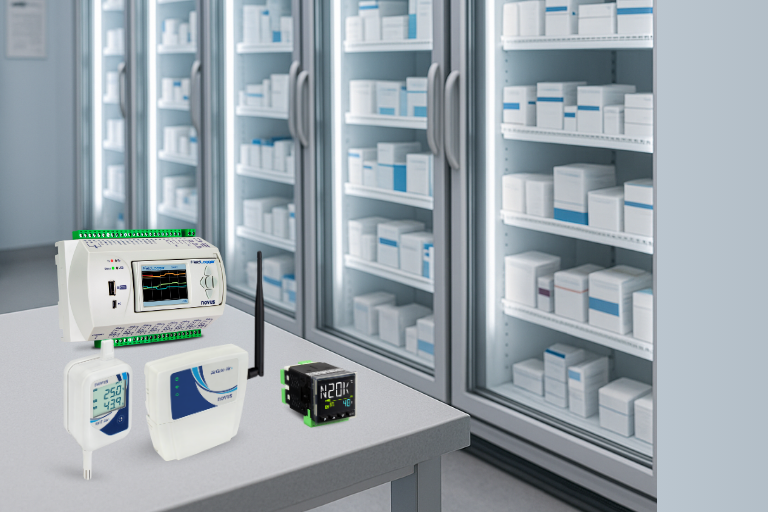
- Climate Air+: a wireless solution for critical environments. High-accuracy sensors and a dedicated gateway centralize temperature and humidity, trigger alarms, and maintain an organized history. Ideal for warehouses, technical rooms, and locations with limited network infrastructure.
- FieldLogger: a multichannel data logger that reads temperature, relative humidity, digital signals, and other variables at high rates. It offers internal memory + SD, local alarms, and open-protocol publishing to cloud/SCADA. In regulated environments, it sustains a full history and auditable events.
- N20K48: a modular controller to act on HVAC, chambers, and ducts. It standardizes loops, eases SCADA integration, and helps keep environments within range consistently.
All NOVUS products can be supplied calibrated from the factory, with INMETRO seals (Brazil) and ILAC accreditation (many countries worldwide).
Monitoring pharmaceutical products is risk control with direct return: it protects quality, reduces avoidable costs, and supports compliance. The difference between “having instruments” and “having a system” lies in the ability to detect early, act quickly, and always provide proof.
With calibrated sensors, loggers with alarms, auditable software, and well-defined routines, operations move from improvisation to controlled mode.
Need to map risk, reduce excursions, and standardize audit-ready reports?
Talk to a NOVUS specialist and evaluate the best architecture for your scenario.