How FieldLogger helped an automotive company with thermal traceability in heat treatment
Monitoring and proving, batch by batch, every heating and cooling stage in heat-treatment furnaces is a clear requirement for quality, safety, and compliance. In critical processes such as carburizing, tempering, and annealing, minutes out of range compromise the hardness, strength, and service life of parts, leading to scrap, rework, and risk of non-conformity. In this context, an automotive manufacturer adopted FieldLogger as the central data logger for the heat-treatment area. What used to be a fragmented recording became a continuous, auditable flow: uninterrupted thermal curves, real-time alarms reaching the right decision-makers, and remote access to history for analysis and audits.
Context and challenge
The plant operated with partial records. Some readings appeared in the SCADA; others depended on spreadsheets with irregular sampling. When Quality needed to prove the thermal behavior of a specific batch, hours were spent cross-checking files, reconciling unsynchronized clocks, and reconstructing the sequence of events.
The challenge was to organize batch-wise curves from multiple furnaces with a robust evidence trail that allowed effortless counter-checks. In parallel, it was necessary to shorten the time between detecting an excursion and taking corrective action, while keeping integration with the existing SCADA and avoiding dependence on proprietary software or panel overhauls that would halt production.
The solution
In partnership with BluControl, the strategy was to consolidate acquisition, storage, and alarms at the edge, close to the process, using open protocols to communicate with the existing SCADA. FieldLogger assumed the role of the central node.
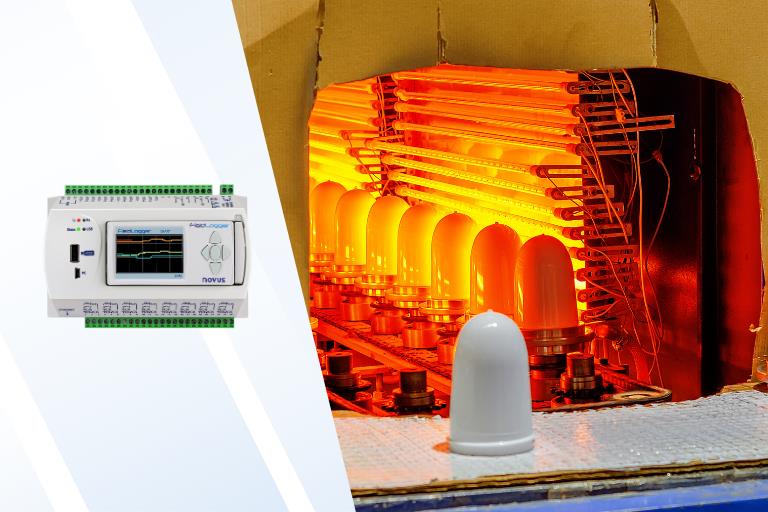
Industrial sensors—especially type-K thermocouples positioned in critical process and product zones—feed the data logger channels. Acquisition runs at a frequency compatible with ramps and soaks of the thermal cycles.
Each sample is locally validated to avoid implausible readings, timestamped in the device itself, and stored in internal memory and on an SD card.
Communication with SCADA uses Modbus TCP, with no middleware. Alarms are layered: local signaling via digital outputs to stack lights/sirens and email notifications to on-call staff and Quality. Remote access enables consultation and support without travel, with role-based permissions.
How it operates
In daily production, a single FieldLogger tracks several furnaces and thermal zones, leveraging existing infrastructure and occupying minimal panel space.
SCADA screens display, in real time, the progress of curves and alarm status. The data logger’s clock, synchronized via NTP, keeps the correct event order.
When the network fluctuates, store-and-forward avoids gaps: local logging continues and, once connectivity returns, history is synchronized without breaking the timeline.
For the lab and process engineering, locating the curve linked to a batch, checking limits, identifying the exact instant of an excursion, and knowing who was notified became a matter of minutes.
Results achieved
Batch traceability became objective: curves organized by furnace and period, with standardized metadata, reduced search time, and analysis subjectivity. Response to deviations became faster because signaling evolved from a discreet on-screen notice to a combination of local alert and remote notification, reaching the right person at the right time.
Data availability no longer depends on the network; communication drops no longer mean loss of evidence. In audits, the process narrative now relies on consistent charts and standardized reports, shortening steps and freeing the team to focus on root-cause analysis rather than file hunting.
Why it worked
Performance stems from four foundations:
Multichannel coverage ensured a faithful representation of the thermal profile, without “saving points” in critical areas.
Open protocols kept integration simple, transparent, and auditable; with Modbus TCP, the data path is clear for Operations, Quality, and auditors.
Redundant storage, split between internal memory and SD card, shielded history against momentary network failures.
Layered alarm logic delivered each event through the channel suited to the context: immediate action on the shop floor and recorded notification to those monitoring remotely.
The combined effect is a resilient, repeatable flow with a consistent evidence trail.
Applied good practices
To avoid becoming “just another collector,” the project established simple, disciplined routines.
A tag dictionary unified naming by furnace, zone, and batch, with unit, limits, and clear owners. The data logger and SCADA clocks were aligned via NTP, eliminating time drifts and seasonal changes. A calibration plan for thermocouples and instruments ensured metrological traceability and reliability over time.
Alarm response was distilled into a one-page runbook, defining who triggers whom, which steps to follow, and how to record the occurrence, reducing shift-to-shift variance. Periodic backups and SD card integrity checks entered the maintenance calendar. Standardized batch reports with digital signatures became the norm for customer requirements and references such as CQI-9.
Integration and expansion
Projects that deliver results start lean and scale in stages. After stabilizing heat treatment, the plant mapped two natural moves:
First, deepen instrumentation in the same furnace by adding points in zones where thermal uniformity needs stronger evidence.
Second, replicate the model in adjacent lines and preheating furnaces, building an end-to-end thermal view of the process.
Thanks to standardization, adding new points or furnaces does not require heavy SCADA redesigns or rewriting integrations.
On the information-security side, segregation between OT and IT networks was preserved, least-privilege access was maintained for remote connections, and credential management followed company policy, avoiding friction between IT and OT.
About FieldLogger
FieldLogger is a multichannel industrial data logger designed for continuous monitoring of variables such as temperature, humidity, and digital/analog signals, with high sampling rates and robust local storage. It integrates with existing systems via open protocols, enables process traceability, and offers edge-level configurable alarms. In regulated environments, it delivers intact history, auditable events, and consistent reports. In distributed scenarios, it publishes data to the cloud or SCADA while keeping operations protected against network failures.
Want reliable thermal traceability in your heat treatment—intact data from sensor to report and alarms that shorten response time?
Contact a NOVUS specialist to assess your application and receive a proposal.