Industrial Automation Trends for 2026: what will change and what will remain next year
Industrial automation has been undergoing one of the greatest transformations of the past decades, mainly driven by new technologies. In 2026, the global scenario points to the consolidation of smart factories, deeper integration between data and operations, and a stronger focus on efficiency, safety, and sustainability.
In this article, we present the most relevant trends expected for 2026 and how they connect with the real demands of the Brazilian and global industry.
- SmartFactories
It is estimated that the global industrial automation market will reach USD 233.6 billion in 2026, driven by the accelerated adoption of IIoT, artificial intelligence, robotics, and integrated digital systems (Source: https://www.researchnester.com/reports/industrial-automation-market/6039).
For industrial customers, this means operating with greater predictability, less waste, and higher operational safety.
Factories are increasingly demanding:
- high-precision sensors for critical variables;
- systems capable of reliably recording and tracing data;
- robust connectivity for fast decision-making;
- modular automation adaptable to variable demands.
Environmental sensors, gateways, IoT devices, and data loggers become key components in this new ecosystem.
- Modular automation
The era of rigid production lines is losing relevance. In 2026, small and medium-sized industries (especially machine manufacturers) will seek incremental automation that evolves through modules and does not require radical changes to the plant.
This approach reduces implementation costs and accelerates return on investment. Modular and customizable controllers gain prominence as they allow quick adjustments as the final product changes, which is essential for dynamic markets.
- AI and data analytics
Automation increasingly operates based on data collected in real time. The combination of:
- smart sensors,
- IoT networks,
- local processing (edge),
- and cloud computing
transforms the production process into a system capable of predicting failures, automatically correcting devices, and optimizing production.
For the global industry, this reduces maintenance costs, minimizes unexpected downtime, and improves operational performance.
- Collaborative robotics and human-centered automation (Industry 5.0)
Robotics continues to advance, but the focus shifts from replacing people to working alongside them.
Collaborative robots (cobots), autonomous systems, and digital platforms converge to improve ergonomics, safety, and productivity.
From 2026 onward, the Industry 5.0 approach gains strength: efficiency and technology working together with human flexibility. This movement is especially relevant in markets with limited labor availability or the need for rapid scalability.
- Sustainability
The global focus is no longer just productivity; it is energy efficiency, waste reduction, and compliance with environmental regulations.
This pushes companies to adopt:
- environmental sensors;
- continuous monitoring of temperature, humidity, and energy;
- digital traceability;
- automatic controls for resource optimization.
Being “environmentally efficient” ceases to be a differentiator and becomes mandatory, especially in regulated sectors such as pharmaceuticals, data centers, food, and storage logistics.
- IT–OT integration becomes the standard
Automation is no longer isolated on the factory floor. IT systems (cloud, enterprise software, data security) and OT systems (control, sensors, machines) now operate together.
This convergence improves:
- traceability;
- response to failures;
- operational visibility;
- bottleneck analysis;
- integration with ERP, MES, and data platforms.
For technology providers, this represents a market that demands connectable devices, open protocols, APIs, and integration with enterprise software.
Count on NOVUS
The trends discussed in this article open clear opportunities for solutions that deliver precision, reliability, and integration. Among the areas with the greatest potential, there is always a NOVUS product that can help.
Monitoring critical environments with high-precision sensors
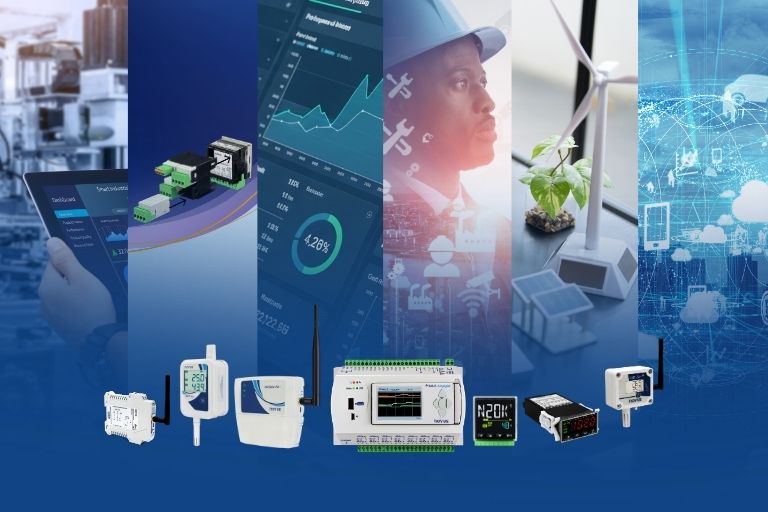
With the global expansion of smart factories, demand grows for high-precision environmental sensors and long-range wireless networks. Technologies such as the Climate Air+ solution, which combines high accuracy, internal memory, and wireless sensors, represent practical examples of the type of architecture increasingly required by the industry for pharmaceutical environments, data centers, and clean rooms.
Telemetry, IoT connectivity, and real-time data integration
As IIoT matures, devices capable of transmitting structured data via MQTT and recording multiple variables become essential. Solutions such as the FieldLogger MQTT, as well as NOVUS industrial gateways, already reflect this transition toward open, integrable ecosystems prepared to operate on modern analytics and operations platforms.
Modular industrial controllers for flexible automation
With the growing adoption of smart manufacturing, machine builders seek modular controllers capable of keeping up with more dynamic production cycles. Controllers such as the N20K48, with flexible I/O and multiple interfaces, demonstrate how modular automation can support reconfigurable lines without requiring radical changes to existing infrastructure.
Traceability, auditing, and reliability in critical processes
More stringent audits and increasingly distributed operations raise the need for continuous and reliable records. Industrial data loggers such as the FieldLogger MQTT, along with sensors with integrated memory like the RHT Air, address this scenario by ensuring data quality, intelligent alarms, and robustness even in harsh environments.
Incremental automation for mid-sized industries
In many international markets, especially mid-sized companies, digitalization occurs in stages. The combined use of wireless sensors, industrial gateways, and compact controllers, such as the AirGate Modbus and the N1020, allows these operations to advance in automation without disruptive investments.
The global industrial automation scenario for 2026 is marked by expansion, digitalization, and technological convergence. Factories of all sizes seek solutions that combine intelligence, modularity, traceability, and efficiency—precisely the areas where NOVUS has been developing solutions to meet national and international demands.
Talk to a specialist and learn how NOVUS can transform your factory into a smart factory.