Connectivity and Compliance: How LogBox LTE Transformed Sanitation Monitoring in Chile
In the sanitation sector, the ability to monitor critical variables in real time can make the difference between an efficient operation and an unplanned shutdown with severe environmental and financial impacts. In the Araucanía region, in southern Chile, this challenge was amplified by an imposing geographical characteristic: a vast territorial extension that rendered traditional communication technologies unviable.
This success case demonstrates how the partnership between NOVUS, the specialized distributor AKOTEK, and a local sanitation company revolutionized the monitoring of Wastewater Treatment Plants (WWTPs) with a solution based on the LogBox LTE, a remote telemetry unit that proved its reliability even under conditions of low cellular signal coverage.
The Challenge
The sanitation company of the Araucanía Region faced a critical limitation in transmitting operational data from its treatment plants spread throughout the region. The existing system used LoRaWAN technology, suitable for moderately close locations, but completely insufficient to cover the large distances between units.
The most important process variables (instantaneous water flow rate and totalized volume at each treatment point) could not be transmitted reliably. This deficiency generated:
- Lack of operational visibility at critical points of the sanitation process;
- Inability to make timely decisions based on real-time data;
- Risk of non-compliance with the rigorous requirements of the Superintendencia de Servicios Sanitarios (SISS), the Chilean regulatory body responsible for sector oversight;
- Dependence on manual data collection or investments in complex and costly local communication infrastructure;
- Lack of traceability of process data for regulatory purposes.
It was necessary to find a solution that guaranteed reliable and continuous connectivity, regardless of the geographical location of the plants, without depending on proprietary networks that are difficult to maintain or on technical limitations of technologies such as LoRaWAN.
The Solution
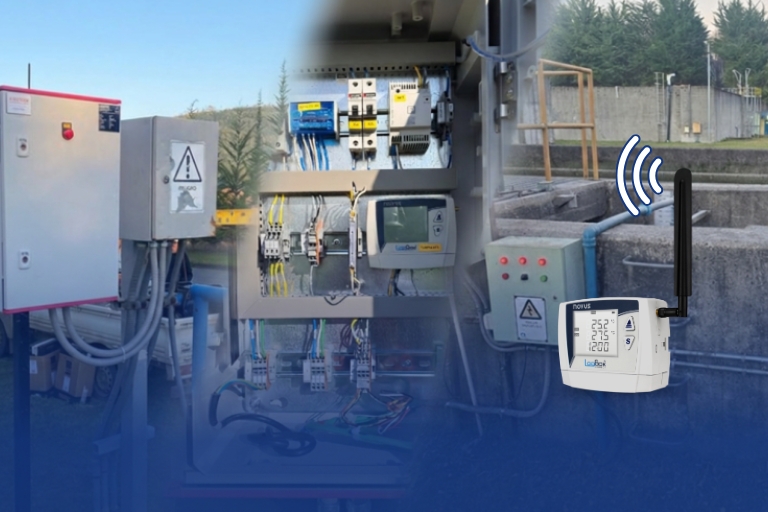
After rigorous technical evaluation, a distributed telemetry architecture was adopted based on 35 NOVUS LogBox LTE units, each strategically installed at critical measurement points of the wastewater treatment plants.
The LogBox LTE was chosen as the best option for this case mainly due to its native LTE connectivity capability to cellular telephone networks, offering geographically superior flexibility and independence from local infrastructure. Unlike LoRaWAN, LTE leverages the existing coverage of the public cellular network, guaranteeing practically unlimited reach in the region.
Technical Topology
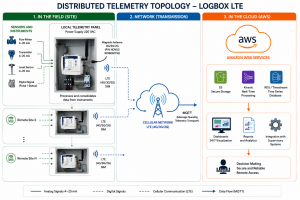
The solution was systematized under a distributed telemetry architecture, composed of multiple remote data acquisition units strategically installed in the field. The topology follows an innovative and decentralized scheme:
In the Field (Terrain):
- Sensors and measurement instruments (flowmeters, transmitters) deliver 4–20 mA analog signals and digital signals.
- LogBox LTE receives, processes, and consolidates data from the instruments.
- Magnetic 4G/3G/2G antennas (NOVUS part number 8816060116) transmit data via a cellular network.
- Local telemetry panel with 220 VAC power supply, installed near the instruments to minimize cabling distances and guarantee operation in indoor and outdoor environments.
Network (Transmission):
- Each LogBox LTE transmits independently and autonomously via the LTE network (4G/3G/2G) using SIM chips.
- Decentralized star topology: multiple points connect directly to the cloud, without dependence on a central hub.
- Communication protocol: MQTT (Message Queuing Telemetry Transport), guaranteeing efficiency and reliability.
In the Cloud (Storage and Analysis):
- Data sent to Amazon Web Services (AWS).
- Centralization, secure storage, and real-time processing.
- Visualization in dashboards and reports accessible 24/7.
- Integration with supervision and decision-making systems.
The Choice of Each Component
| Component | Technical Function | Benefit |
| LogBox LTE | Data acquisition and transmission | Local processing + connectivity |
| 4-20 mA Signals | Interface with field sensors | Robust industrial standard, immune to noise |
| Magnetic 4G/3G/2G Antenna | Connection to mobile network | Quick installation, multi-band compatibility |
| 220 VAC Panel | Local electrical power supply | Energy stability, no battery dependence |
| MQTT Protocol | Data transmission to the cloud | Lightweight and efficient for low bandwidth |
| AWS | Storage and processing | Scalability, security, and global accessibility |
Field Validation
Before committing to the solution at scale, a pilot project was carried out at one of the 35 plants, strategically chosen by the client for presenting one of the worst telephone signal coverage conditions in the region. The objective was clear: to validate whether the equipment could function even in adverse scenarios.
The result was conclusive and decisive: even under low signal coverage conditions, the LogBox LTE demonstrated excellent cellular network connectivity capability and correct transmission of process variables to the AWS cloud platform. This test eliminated all technical doubts and gave full confidence to proceed with large-scale deployment across the 35 plants.
Partner Role: AKOTEK as Strategic Integrator
AKOTEK was fundamental to the success of this project. Specialized in the commercialization of automation equipment and industrial processes, the company offers a complete approach:
- Products: High-quality and innovative equipment to guarantee better performance and availability in industrial plants.
- Services: Highly qualified professionals with extensive experience in different industries, offering technical assistance with the highest standards.
- Solutions: A combination of instrumentation and reliable systems to improve productivity and reduce costs in a sustained manner.
- Industry 4.0 Integration: Combination of technologies to make information available in real time, leading to timely decisions and greater operational efficiency.
With strategic presence in the 9th to the 12th region of Chile, AKOTEK has commercial agreements with nationally and internationally recognized brands, allowing it to combine cutting-edge technologies to help its clients improve processes and reduce costs sustainably.
Results and Benefits Achieved
The implementation of the telemetry system based on LogBox LTE generated measurable and strategic impacts on the operation:
- Real-time Remote Monitoring
Continuous and uninterrupted visibility of critical variables of instantaneous flow rate and totalized volume, allowing agile diagnosis of anomalies and preventive intervention before failures become costly operational shutdowns.
- Regulatory Compliance Guaranteed
Automatic and continuous sending of process variables to the Superintendencia de Servicios Sanitarios (SISS) ensured full compliance with current legal regulations, eliminating risks of fines, legal liabilities, and regulatory exposure.
- Significant Improvement in Operational Supervision
Centralization of data in easy-to-interpret dashboards allowed the operational team to monitor multiple plants simultaneously, detecting patterns and trends that were previously invisible.
- Reduced Dependence on Local Infrastructure
By using the public LTE cellular network, it was possible to eliminate the need to build, maintain, and update proprietary communication infrastructure, resulting in:
- Reduction of capital costs.
- Decrease in operational maintenance costs.
- Simplification of operation.
- Scalability without infrastructure investments.
- Proven Reliability Over Long Distances
LTE transmission guarantees stable communication even between plants separated by tens of kilometers, completely overcoming the limitations of the previous LoRaWAN and providing the necessary coverage for the entire Araucanía Region.
- High Expansion Potential
The success of the initial implementation paved the way for a clear expansion opportunity: the sanitation company identified the need to integrate the same quantity of equipment (35 LogBox LTE units) to monitor another critical stage of the water treatment process, demonstrating the confidence gained with the solution.
Project Timeline and Scope
| Aspect | Detail |
| Implementation Period | Approximately 10 months (from negotiation to complete activation) |
| Number of Equipment | 35 LogBox LTE units + 35 magnetic 4G/3G/2G antennas |
| Plants Served | 35 WWTPs distributed in the Araucanía Region |
| Monitored Variables | Instantaneous flow rate and totalized volume of wastewater |
| Geographical Coverage | Entire Araucanía Region, Chile |
| Internal Document | BMJZ9FO7C9-EOWVZX1 |
Technology That Transforms Critical Operations
The LogBox LTE case in the Araucanía Region evidences how technological innovation applied to sanitation can overcome geographical, operational, and regulatory barriers. The combination of a distributed telemetry architecture, reliable connectivity via LTE cellular network, integration with cloud platforms, and partnership with specialized integrators resulted in:
- Greater operational efficiency through real-time visibility.
- Security in data transmission with the MQTT protocol and cloud storage.
- Guaranteed compliance with regulatory bodies.
- Scalability for future expansions with minimal additional investment.
- Justified ROI by elimination of complex infrastructure.
For projects that demand reliable monitoring in areas of large geographical extension and high complexity — whether in sanitation, industry, or infrastructure — LogBox LTE and NOVUS distributed telemetry are consolidated as the right choice.
Count on NOVUS
Want to implement a similar distributed telemetry solution in your operation? Talk to our specialists and discover how LogBox LTE can transform your process monitoring.